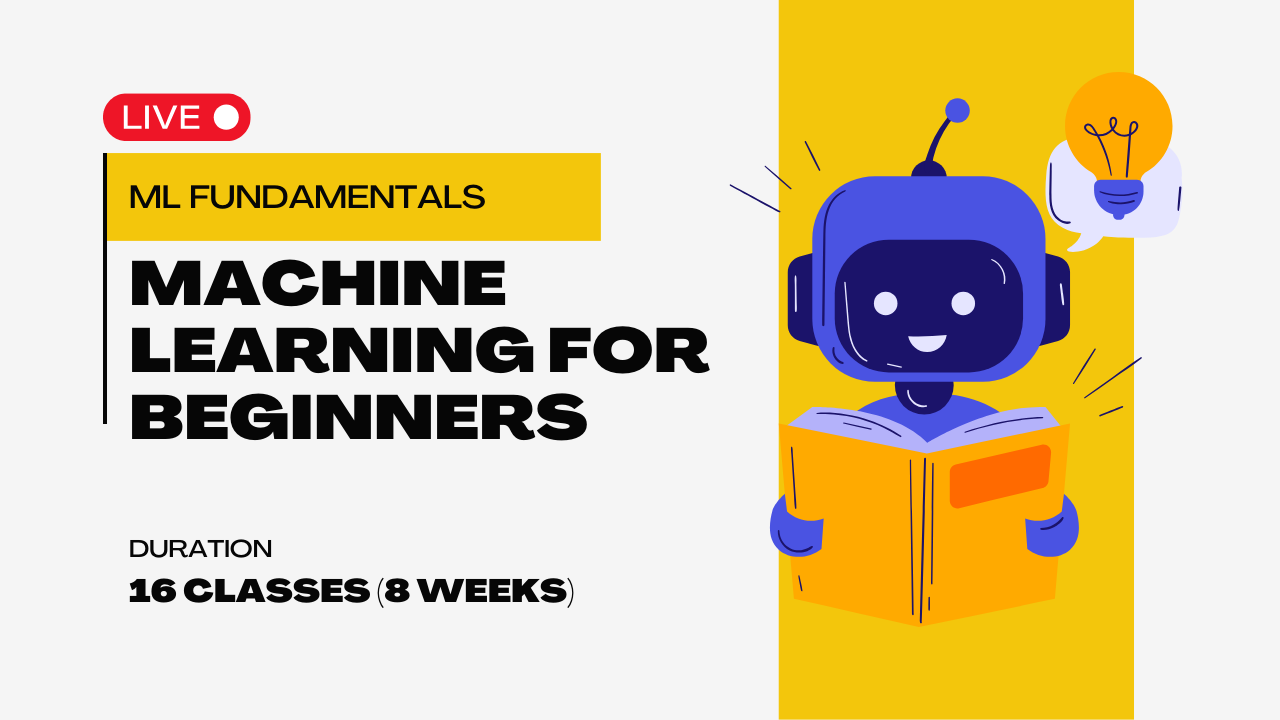
Master the basics of modern machine learning with expert-led case studies. Build your skills through real projects like prediction, classification, clustering, and smart search using Python and practical tools.
Machine learning powers smart technology everywhereโfrom apps to online recommendations. This course series makes it simple: learn the main ideas, build hands-on projects, and see how machine learning works in the real world.You'll start by exploring how computers learn from data, then quickly move into building models that can predict outcomes, sort information, find patterns, and retrieve data. You'll use Python and popular libraries like scikit-learn and TensorFlowโno advanced math or experience needed.Lessons are delivered through easy-to-follow case studies, working directly with real data. By the end, you'll be able to use machine learning tools to create your own smart apps and solve real problems.
Basic familiarity with Python programming can be an added advantage, as it helps learners understand examples and practice exercises more easily. However, even those with limited experience can follow along with proper guidance. There is no requirement for advanced mathematics, as all concepts are explained in a simple and practical manner. Learners should have a genuine interest in exploring and solving problems using data, as this course focuses on real-world applications. Most importantly, students should be willing to learn by doing, actively participating in hands-on tasks, experiments, and practice activities to build confidence and understanding step by step.
Overview and Concepts
Learn core ideas behind machine learning, including how systems learn from data and improve over time.
Case Study Approach
Discover how real-world case studies are used to connect theory with practice.
Types of Learning
Get introduced to supervised, unsupervised, and reinforcement learning.
Data Fundamentals
Understand what makes a good dataset and how to identify key variables.
Data Cleaning Techniques
Handle missing values, remove outliers, and prepare data for machine learning.
Visualization & Insights
Use tools like Matplotlib and Pandas to explore patterns and trends visually.
Regression Basics
Grasp how regression is used to forecast numbers and continuous outcomes.
Model Building
Create simple linear regression models to predict housing prices or sales data.
Evaluation Metrics
Measure model accuracy using metrics like MAE, RMSE, and Rยฒ.
Categorizing Data
Train models to classify data into distinct categories such as spam vs. non-spam.
Algorithms in Action
Implement logistic regression, k-nearest neighbors, and decision trees.
Practical Applications
Work on mini-projects like sentiment analysis or loan default prediction.
Grouping Unlabeled Data
Learn how clustering algorithms uncover hidden patterns in data.
Popular Techniques
Experiment with K-Means, DBSCAN, and hierarchical clustering methods.
Real Use-Cases
Apply clustering to customer segmentation or document organization.
Simplifying Complex Data
Understand why reducing data dimensions improves model performance.
Feature Selection & Extraction
Use techniques like PCA (Principal Component Analysis) to identify important features.
Practical Lab
Refine a dataset to improve speed and accuracy of your models.
Model Tuning
Apply hyperparameter tuning to improve your model performance.
Cross-Validation
Learn best practices for validating results and preventing overfitting.
Performance Comparison
Compare different models and choose the most effective one for your task.
End-to-End Machine Learning Pipeline
Integrate data preparation, model training, and evaluation in one complete workflow.
Model Deployment
Learn how models are shared or embedded into real-world applications.
Capstone Project
Complete a final case study where you build, test, and present your own ML solution.
Discover our most popular courses that students are loving right now.
Headphone or Speakers for clear audio, Webcam & Microphone.
PDF Reader (for notes and study materials).
Stable Internet with at least 2 Mbps speed for smooth video streaming and interactive content.
Smartphone, Tablet, Laptop or Desktop Computer.
Talk to our expert mentors directly or book a personal 1-on-1 counseling session to clear all your doubts.
A comprehensive support ecosystem designed to guide you at every step of your educational and professional growth.
Comprehensive curriculum from ML experts and industry practitioners.
Cloud-based environments to practice ML workflows in real-time.
Get technical queries resolved directly by instructors and ML engineers.
Instant doubt resolution
Industry-Standard ML Tools & Libraries
Discover more similar content to expand your knowledge and sharpen your skills.
A structured journey designed to take you from beginner to industry-ready professional.
The journey begins with your first comprehensive module. In this first stage, you'll explore the fundamental question: "What is Machine Learning?" and learn to differentiate between supervised, unsupervised, and reinforcement learning approaches.
Guided by hands-on exercises, you'll learn the essential Python libraries for ML. You'll practice data cleaning, transformation, and feature engineering using NumPy, Pandas, and scikit-learn.
Once comfortable with Python, the focus shifts to core ML algorithms. You'll be introduced to how models are trained, validated, and optimized, exploring regression, classification, and clustering techniques.
This is where learning turns into real-world application. Using the skills from the previous steps, you'll build end-to-end ML pipelines, from data ingestion to model deployment and monitoring.
Professional growth happens through practice! In this stage, you'll deploy models to cloud platforms, discuss ethical AI considerations, and present your capstone project to demonstrate your expertise.
After completing all the modules, you'll have mastered advanced concepts including deep learning, neural networks, and MLOps, ready to tackle complex real-world ML challenges independently.
Your feedback matters! Share your learning experience to help other students choose their path and improve our community.
Check out our best products made to make learning fun, easy and super exciting for everyone.
Everything you need to know about The Complete Machine Learning Masterclass
No prior experience in machine learning is required. This course is designed for beginners and starts from the basics. All concepts are explained step by step using real-world examples, making it easy for learners with little or no background to follow along.
Basic familiarity with Python is helpful but not compulsory. The course includes guided explanations of Python concepts and libraries used in machine learning, allowing beginners to learn alongside the course without feeling overwhelmed.
No advanced mathematics is required. The focus is on practical understanding rather than heavy formulas. Mathematical ideas are explained intuitively, so learners can understand how models work without needing a strong math background.
Learners receive access to instant doubt support and one-on-one mentorship sessions where they can ask questions, clarify concepts, and get guidance directly from instructors and ML experts throughout the learning journey.
Yes. By the end of the course, you will be able to build complete machine learning workflowsโfrom data preparation and model training to evaluation and basic deploymentโusing industry-standard tools.
Join viLab โ as a student, school partner, or educator.